Showing posts with label Antipodes. Show all posts
Showing posts with label Antipodes. Show all posts
Monday, 25 April 2011


Saturday, 22 January 2011
The Brisbane Floods of 1893.

From The Brisbane Courier, 6 February 1893.
DISASTROUS FLOODS.
UNPRECEDENTED RISE IN THE RIVER.
LOSS OF LIFE.
FEARFUL DESTRUCTION Of PROPERTY
INDOOROOPILLY RAILWAY BRIDGE
WASHED AWAY.
SCENE ON THE RIVER.
DREDGES AND STEAMERS ADRIFT.
__________
THE WATER RECEDING.
The unprecedented floods from which this part of the colony is at present suffering have, since last publication, reached the magnitude of a widespread calamity. A number of lives have been lost ; hundreds of persons have been deprived of their homes and of the whole of their little possessions, and the loss of merchantable goods cannot at present be estimated. At the time of writing we are able only to give an outline of the chief occurrences of the past forty-eight hours in Brisbane, but there is sufficient to show that the flood is one altogether without parallel since the settlement of the Brisbane district. Not until roads again become passable will it be possible to form anything like an exact idea of the mischief wrought. Brisbane was last night without communication by road, rail, or telegraph with any of the outlying districts, as indeed it has been since Friday night, so that the facts pro- curable were simply those relating to the immediate vicinity of the capital. Last night the water was between 11ft, and 12ft. above the flood mark of 1890 ; but in spite of local rain the water slowly receded from 9 o'clock.
From about midnight on Saturday until yesterday evening very little rain fell, and it was generally hoped that fine weather would set in for a time at all events ; but by sunset last evening steady rain again began, and the night as it fell over the city was perhaps the most gloomy that has yet been experienced. No gas had been available since an early hour on Saturday night, and though some lamps in Queen and George streets were lit by Messrs. Barton, White, and Co. from electricity generated at the Government Printing Office, this served to light but a small portion of the inundated streets.
Every effort is being made to supply the immediate needs of the suburban residents driven from their homes, and while many in various districts were accommodated in empty houses, shelter and relief were also afforded at the Town Hill and other public places. Police and Defence Force men worked hard to save life and minimise, where possible, the destruction wrought, and many young men, members of athletic clubs and football and cricket teams, worked with a will, plying in boats the whole of Saturday night from point to point where help was needed.
Wednesday, 29 December 2010
Last Rites
I was at the MCG yesterday: it certainly felt like the Last Rites on Australia’s era of cricket dominance.
Really, it ended a while ago, but Australian fans are finally accepting it now. Only England in Australia could truly bring that message home.And frankly, I for one am glad its over. At one point the dominance became positively tedious to watch.
I must say: the England fans, the Barmy Army, are an absolute joy to behold. Great, good-natured, imaginative chants, and hilarious piss-taking “eg God Save YOUR Queen. Long too-ooo reign over YOU!” LOL!! I almost wanted to join them (like most of the Kiwis at the match did, incidentally).
Meanwhile my compatriots were doing no better than “oi oi oi” or “[England player X] is a wanker!”. It was embarrassing to watch. Pick up yer damn act Australian fans!
I for one miss streaking and pitch invasions. That was Australian sport watching at its most irreverent and finest: a drunken nudist being chased by coppers. Surely that was what an Australian summer of cricket was really all about!
Now I fear we’re just dull minded, insular boors. Time for fans to take a good look at themselves too I’d say. Hopefully sporting failure will provoke some reflection. Doubt it though!
Good on you England – you won in the best of sporting spirits too. Remind us all how its done.
Really, it ended a while ago, but Australian fans are finally accepting it now. Only England in Australia could truly bring that message home.And frankly, I for one am glad its over. At one point the dominance became positively tedious to watch.
I must say: the England fans, the Barmy Army, are an absolute joy to behold. Great, good-natured, imaginative chants, and hilarious piss-taking “eg God Save YOUR Queen. Long too-ooo reign over YOU!” LOL!! I almost wanted to join them (like most of the Kiwis at the match did, incidentally).
Meanwhile my compatriots were doing no better than “oi oi oi” or “[England player X] is a wanker!”. It was embarrassing to watch. Pick up yer damn act Australian fans!
I for one miss streaking and pitch invasions. That was Australian sport watching at its most irreverent and finest: a drunken nudist being chased by coppers. Surely that was what an Australian summer of cricket was really all about!
Now I fear we’re just dull minded, insular boors. Time for fans to take a good look at themselves too I’d say. Hopefully sporting failure will provoke some reflection. Doubt it though!
Good on you England – you won in the best of sporting spirits too. Remind us all how its done.
Monday, 5 July 2010
Oi oi oi...vey.
I'm in New Zealand, having a holiday with the family, and frankly... I'm outraged.
Everywhere I go, customary title over income-generating tourist sites appears not only to provide economic opportunity and employment for rural Maori, but also generates business opportunities for the general community through site lease arrangements.
Stupid Kiwis: can't they see its better to oppose native title and then whinge interminably about indigenous people on welfare?
Everywhere I go, customary title over income-generating tourist sites appears not only to provide economic opportunity and employment for rural Maori, but also generates business opportunities for the general community through site lease arrangements.
Stupid Kiwis: can't they see its better to oppose native title and then whinge interminably about indigenous people on welfare?
Monday, 14 June 2010
Ned Kelly: 'Nobody knows anything about my case except myself'

Sidney Nolan (1945). In my ill-informed opinion, the most evocative of the Ned Kelly series.
Saturday, 13 February 2010
Ghosts of the Yeoman Dream: Lucky Country (2009)
For this to me is what New Australia means, to the landless, the homeless . . . to those who long to be manly, to be true... Come together, in all unselfishness, to trust each other and to be free. To live simply, to work hardly, to win not the gold that poisons but that home life that saves....
I really never thought I'd see an Australian film open with the words of William Lane, the 1890s utopian socialist and teetotaler who took 400 Australians to Paraguay in 1893. Somehow the movie Lucky Country (2009) passed me by without a trace last year. But its a cracker. Best Australian film I've seen in years. Where Lane imagined a collective settlement in the heart of South America, this film is set on a harsh, marginal individual selection somewhere in Australian scrub in 1902. Australian land reform movements of the late nineteenth century did lead to some marginal property being forced from squatters hands by colonial governments, as a sop to the Yeoman dream: a vision of an agrarian society of smallholders, of a man and his family leading a stolid, moral life on the land, away from urban vice. Of course, in the land of the long white scam, most decent land actually went to the squatters' dummy bidders, and this sets the stage for the film: one Yeoman nightmare, shortly after federation.
The swaggies don't pass by anymore, but three Boer war veterans returning in failure from prospecting do. The rest I'll leave, in case you want to see it.
"Bet ya thought it was going to be all Henry bloody Lawson didn’t ya?".
You can see a trailer here.
I really never thought I'd see an Australian film open with the words of William Lane, the 1890s utopian socialist and teetotaler who took 400 Australians to Paraguay in 1893. Somehow the movie Lucky Country (2009) passed me by without a trace last year. But its a cracker. Best Australian film I've seen in years. Where Lane imagined a collective settlement in the heart of South America, this film is set on a harsh, marginal individual selection somewhere in Australian scrub in 1902. Australian land reform movements of the late nineteenth century did lead to some marginal property being forced from squatters hands by colonial governments, as a sop to the Yeoman dream: a vision of an agrarian society of smallholders, of a man and his family leading a stolid, moral life on the land, away from urban vice. Of course, in the land of the long white scam, most decent land actually went to the squatters' dummy bidders, and this sets the stage for the film: one Yeoman nightmare, shortly after federation.
The swaggies don't pass by anymore, but three Boer war veterans returning in failure from prospecting do. The rest I'll leave, in case you want to see it.
"Bet ya thought it was going to be all Henry bloody Lawson didn’t ya?".
You can see a trailer here.
Tuesday, 26 January 2010
Ostraya Day: view from the fort parapets
You know, I remember the good old days when having the Oz flag publicly displayed was a sure sign of either being an extremist Larouchite, a gun owner, or mentally unwell. Now its like, Gen-Y chic or something. Certainly, its become nativist protest wear - reverently displayed on on the boardies, a towel, or the car.
I'm starting to miss Australians' deep-rooted suspicion of jingosim - which as others have noted, dates back at least to the failed conscription referenda of WW1. I for one liked that Australia better - we support our volunteer soldiers, but you can take your compulsory imperial /militarist hoohaa and shove it, and the same goes for the ra-ra patriotism of the Yanks. Let's recall that the Australian people voted no to the imperial conscriptors twice; they stopped even asking us when Vietnam came along. Basically, I think 'the kids are alright', but they need to know the history.
And I'd really like to see an Australian politician say it: many Australians are wary of American-style showy patriotism and jingoism - but no less proud of the country for that. They wonder what someone wrapped in the flag is trying to flog them. I reckon it'd go down a treat. Knock this "nationalism-as-majority-ethnic-gang" bullshit on the head.
And one doesn't like to over-dramatise, but I do feel Cronulla kinda changed it for everyone. I'm not sure anyone contemplating a harmless little flag wave can truly avoid the new semiotics. For example, it concerned me that several non-Anglo background colleagues were saying "have a good Australia day!" yesterday as we left work - like that's necessary to say these days, or there'll be riots! There's something kinda fucked up about all this. And as another friend pointed out, it isn't so long ago that there was a general sense of ambivalence about the embarrassing Britishness of the flag. I don't know whats happened, but I miss the lack of popular resonance with our national symbols.
So I'll come out and say it: I for one am still proudly embarrassed by the bastard Jack. And guess what: this is my country too. And aside from flag-totin' bogan gangs intimidating other citizens on the beaches - I mostly love it. So step off with your kiss-da-flag bullshit.
John Birmingham's take is here.
I'm starting to miss Australians' deep-rooted suspicion of jingosim - which as others have noted, dates back at least to the failed conscription referenda of WW1. I for one liked that Australia better - we support our volunteer soldiers, but you can take your compulsory imperial /militarist hoohaa and shove it, and the same goes for the ra-ra patriotism of the Yanks. Let's recall that the Australian people voted no to the imperial conscriptors twice; they stopped even asking us when Vietnam came along. Basically, I think 'the kids are alright', but they need to know the history.
And I'd really like to see an Australian politician say it: many Australians are wary of American-style showy patriotism and jingoism - but no less proud of the country for that. They wonder what someone wrapped in the flag is trying to flog them. I reckon it'd go down a treat. Knock this "nationalism-as-majority-ethnic-gang" bullshit on the head.
And one doesn't like to over-dramatise, but I do feel Cronulla kinda changed it for everyone. I'm not sure anyone contemplating a harmless little flag wave can truly avoid the new semiotics. For example, it concerned me that several non-Anglo background colleagues were saying "have a good Australia day!" yesterday as we left work - like that's necessary to say these days, or there'll be riots! There's something kinda fucked up about all this. And as another friend pointed out, it isn't so long ago that there was a general sense of ambivalence about the embarrassing Britishness of the flag. I don't know whats happened, but I miss the lack of popular resonance with our national symbols.
So I'll come out and say it: I for one am still proudly embarrassed by the bastard Jack. And guess what: this is my country too. And aside from flag-totin' bogan gangs intimidating other citizens on the beaches - I mostly love it. So step off with your kiss-da-flag bullshit.
John Birmingham's take is here.
Postscript: An ex-ADF friend of mine noted today that the military has been in a fully fledged recruitment crisis throughout the entire Howard-and-beyond revival of jingoism, flag-waving, Gallipoli trips etc. Much as I support not signing up – I think it aptly highlights the bullshit factor of the whole thing.
Saturday, 9 January 2010
'Brulliant rivolution: Two guys shitting themsulves un the bush'
 Haha! New Zealand, 1982.
If those two concepts aren't exciting you already, make sure you see Sleeping Dogs (1982), starring Sam Neill.
The premise is that a general strike occasions the rise of an authoritarian military government in New Zealand.
Repression and general mayhem ensue.
Sam Neill is your reluctant hero in the resistance. As it happens, its ekshually a great film, and the first NZ film ever screened in the US of Ay, Bro.
Saturday, 6 June 2009
'I gits a stretch fer stoushing Johns' - The Sentimental Bloke (1919)

I've just seen the DVD reprint (with soundtrack by Jen Anderson) of Raymond Longford's classic silent film The Sentimental Bloke. Normally bored and already squirming in my chair by the very idea of silent film, I was quite taken with it - it really is an engaging movie, capturing the wonderful vernacular of C.J. Dennis' verse novel.
C.J. himself (who had only published it 4 years earlier) appears at the start of the film. The main female lead (Lottie Lyell) was the de facto partner (and reputed co-director) of the credited director Raymond Longford, who you can see interviewed shortly before his death in 1959 on the extras. When a print of the film was rediscovered in the 1950s and re-released, he was found - then in his 80s - working as nightwatchman on the docks.
There's some great footage of Manly and Wolloomoolloo after the war, including a genuine digger in the background on the ferry as Bill and Doreen go on their first date. I really enjoyed it, and partly, if you'll allow the digression, because I once recorded an album at Jen Anderson's studio back in my musician days. A friend and I - both in other bands at the time - recorded a lowly independent CD there as a two-piece with some spare songs our respective outfits weren't using. He suggested Jen Anderson's studio - then in Northcote - where his band had recorded before. We both lived in Brisbane then, and it was a great week down here recording and louching around with muso friends and acquaintances.
Ten years later and I live a few streets away - though Jen herself has moved elsewhere in Melbourne. Suffice to say, she really was a great producer and sound technician - and I am truly blessed - as a part-timer then, and no longer in the game - to have Jen Anderson's violin solos on a song or two of my own. It really lifted the whole thing to another plane - and made it sound like I knew what I was doing. Which, by and large, I didn't.
Coming from Brisbane, I didn't realise then how BIG her band Weddings, Parties, Anything were in Melbourne. We went to a party and met them all - they were really great people. Top memories - thanks Jen! Whatever you're up to now. Anyway, the point is: I think the sound track is beautiful, and works seamlessly.
Oh yeah - and the title of my post. Watching Underbelly this last year, I got to wondering where this "Jacks" slang for coppers had come from, as I 'd never heard it. And lo! They appear as the "Johns" in C.J. Dennis. Mystery solved?
Saturday, 25 April 2009
To the Women of Australia (1915)

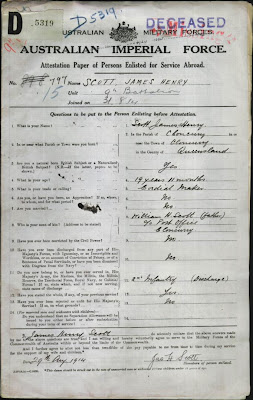
James Henry Scott, 19, of Cloncurry, QLD, enlisted in August 1914, in the first few weeks of the war, and was drafted to the 9th Battalion. The 3rd Brigade of the 9th was the covering force for the ANZAC landing on 25 April 1915, and was the first ashore at around 4.30 am.
He did not live to see the sunrise.
When my grandmother died in 2005, I inherited this badge, 'To the Women of Australia'. My grandmother's writing is on the card. James was her uncle.
This badge possibly went first to his sister, my great-grandmother, as their mother is referred to as the 'late' Catherine Scott in military grave records. Or perhaps James' mother died, grief-stricken, between 1915 and the formal headstone finally being laid at Gallipoli. I don't know.
There's a lot of respect, a lot of ceremony, and a lot of remembrance of WW1 these days - but I'm not convinced any of that truly captures what must be been the real legacy in the decades that followed: the grief. This badge - and the 61,720 like it - is a small reminder of the unbearable personal sorrow that must have rent this country, town by town, street by street, room by childhood room.
Sunday, 19 April 2009
Prime Ministerial Trivia
I've just been mucking around on the National Archive's Australian Prime Ministers site - and from there I bring you the following trivial notes about each of them, selected on the highly scientific basis of what interested me most within 10 seconds:
Edmund Barton : nicknamed 'Toby Tosspot' by the Bulletin.
Alfred Deakin: only PM to reject title 'Right Honorable'.
Chris Watson: First Labor PM in the world, established the solidarity rule by which he was expelled from the Labor Party. Youngest ever PM at 37.
George Reid: only Australian to serve in all three legislatures – colonial, Commonwealth, and British; first former Australian PM to die.
Andrew Fisher: first Prime Minister to hold a majority in both the Senate and the House of Representatives, in 1910.
Joseph Cook: initiated first double dissolution of Commonwealth parliament, dubbed ‘the most humourless’ of the prime ministers.
Billy Hughes: 51 years as an MHR – the longest serving Australian federal parliamentarian. This does not include his prior 7 years as a NSW MLA 1894-1901. Woah!
Stanley Bruce: we all know that along with John Howard, he is one of two Prime Ministers to lose their seats while in office - but did you know he was the only Prime Minister laid to rest in Canberra?
Jim Scullin: first Catholic Prime Minister, and (possibly not entirely unrelated to the first fact) the only red-headed PM.
Joseph Lyons: first PM to win three successive elections, and with Reid (NSW), one of two PMs to have been a State Premier (Tas). First to die in office.
Earl Page: one of the first Australians to own a car (in 1904), record for the shortest official stay in Britain – 1 day (1925).
Robert Menzies: one of three former Prime Ministers awarded Japan’s Order of the Rising Sun, First Class! The others are Edmund Barton and John McEwen.
Arthur Fadden: PM for 6 weeks, but longest serving acting PM (nearly 2 years) while Menzies was tarting around Britain between 1949 and 1958.
John Curtin: the only Prime Minister to have been in jail (as an anti-conscriptionist in 1916).
Francis Forde: shortest term in office at eight days. On 11 July this year, should he make it, Whitlam will beat Forde's record of 92 years as longest-lived former PM.
Ben Chifley: refused to wear ceremonial clothes and became a Privy Councillor in his own suit in 1945.
Harold Holt: was a federal parliamentarian for 32 years - the same duration as Robert Menzies.
John McEwen: record for longest service in parliament before becoming PM (33 years). Holt 2nd at 30 years. Naturally, Menzies is the origins of these complaints.
John Gorton: only PM sworn in while a Senator, for three weeks was PM without holding a seat in the House of Reps. Only PM to have a non-Australian wife (American).
William McMahon: despite being 2nd oldest to become PM at 63 (McEwen oldest at 67), fathered his youngest child while in office. 'Respek!', as Ali G would say.
Gough Whitlam: only Prime Minister to grow up in Canberra, though spent the earliest part of life in Melbourne. Will (hopefully) become the longest-lived Australian PM on July 11 this year. Go Gough! Its time!
Malcolm Fraser: in 1955 was then the youngest MP to ever enter parliament - 25 years old. Keating matched this in 1969. Came to office with greatest winning margin in federal history (1975), and lost office with (joint) largest ALP victory in 1983.
Bob Hawke: 1983 win roughly ties with Curtin's 1943 win for largest ALP winning margin ever.
Paul Keating: third longest serving federal treasurer, after Costello and Fadden. Consequently, 2nd longest serving treasurer to ever become an Australian PM. ;)
John Howard: only Liberal Party Prime Minister educated in government schools, campaigned for the Conservative Party in Britain’s 1964 election. Other rare distinctions include losing his seat while in office.
Kevin Rudd: info on site "under development". But here's one: he used to clean Laurie Oakes' house while a student at ANU. Ewww!
Edmund Barton : nicknamed 'Toby Tosspot' by the Bulletin.
Alfred Deakin: only PM to reject title 'Right Honorable'.
Chris Watson: First Labor PM in the world, established the solidarity rule by which he was expelled from the Labor Party. Youngest ever PM at 37.
George Reid: only Australian to serve in all three legislatures – colonial, Commonwealth, and British; first former Australian PM to die.
Andrew Fisher: first Prime Minister to hold a majority in both the Senate and the House of Representatives, in 1910.
Joseph Cook: initiated first double dissolution of Commonwealth parliament, dubbed ‘the most humourless’ of the prime ministers.
Billy Hughes: 51 years as an MHR – the longest serving Australian federal parliamentarian. This does not include his prior 7 years as a NSW MLA 1894-1901. Woah!
Stanley Bruce: we all know that along with John Howard, he is one of two Prime Ministers to lose their seats while in office - but did you know he was the only Prime Minister laid to rest in Canberra?
Jim Scullin: first Catholic Prime Minister, and (possibly not entirely unrelated to the first fact) the only red-headed PM.
Joseph Lyons: first PM to win three successive elections, and with Reid (NSW), one of two PMs to have been a State Premier (Tas). First to die in office.
Earl Page: one of the first Australians to own a car (in 1904), record for the shortest official stay in Britain – 1 day (1925).
Robert Menzies: one of three former Prime Ministers awarded Japan’s Order of the Rising Sun, First Class! The others are Edmund Barton and John McEwen.
Arthur Fadden: PM for 6 weeks, but longest serving acting PM (nearly 2 years) while Menzies was tarting around Britain between 1949 and 1958.
John Curtin: the only Prime Minister to have been in jail (as an anti-conscriptionist in 1916).
Francis Forde: shortest term in office at eight days. On 11 July this year, should he make it, Whitlam will beat Forde's record of 92 years as longest-lived former PM.
Ben Chifley: refused to wear ceremonial clothes and became a Privy Councillor in his own suit in 1945.
Harold Holt: was a federal parliamentarian for 32 years - the same duration as Robert Menzies.
John McEwen: record for longest service in parliament before becoming PM (33 years). Holt 2nd at 30 years. Naturally, Menzies is the origins of these complaints.
John Gorton: only PM sworn in while a Senator, for three weeks was PM without holding a seat in the House of Reps. Only PM to have a non-Australian wife (American).
William McMahon: despite being 2nd oldest to become PM at 63 (McEwen oldest at 67), fathered his youngest child while in office. 'Respek!', as Ali G would say.
Gough Whitlam: only Prime Minister to grow up in Canberra, though spent the earliest part of life in Melbourne. Will (hopefully) become the longest-lived Australian PM on July 11 this year. Go Gough! Its time!
Malcolm Fraser: in 1955 was then the youngest MP to ever enter parliament - 25 years old. Keating matched this in 1969. Came to office with greatest winning margin in federal history (1975), and lost office with (joint) largest ALP victory in 1983.
Bob Hawke: 1983 win roughly ties with Curtin's 1943 win for largest ALP winning margin ever.
Paul Keating: third longest serving federal treasurer, after Costello and Fadden. Consequently, 2nd longest serving treasurer to ever become an Australian PM. ;)
John Howard: only Liberal Party Prime Minister educated in government schools, campaigned for the Conservative Party in Britain’s 1964 election. Other rare distinctions include losing his seat while in office.
Kevin Rudd: info on site "under development". But here's one: he used to clean Laurie Oakes' house while a student at ANU. Ewww!
Saturday, 11 April 2009
Failed Federal Election Slogans 1951-2007
Election slogans tend to be left motherless at the best of times - even winning campaigns are generally sick to death of them by the end. And naturally, losing slogans are well and truly consigned to to the dustbins of history. So, I did of bit of scratching around, and found them in a journal article, cited below. A few initial comments and curios:
Year - Losing Party - Slogan/s
1951 ALP - What Labor promises, Labor will do
Source: Sally Young (2006), Australian Election Slogans, 1949-2004: Where Political Marketing Meets Political Rhetoric, Australian Journal of Communication, 33(1):pp 1-20
- Check out 1969! It practically sounds like an invitation to an orgy - possibly at Don's Party.
- The second slogan from 1998 ('Australia deserves better') was a recycle of the winning slogan from the winning 1993 campaign.
- Curiously, Menzies won in 1949 with "It's time for a change" - which demonstrates that the most famous electoral slogan of all was not exactly an original.
Year - Losing Party - Slogan/s
1951 ALP - What Labor promises, Labor will do
1961 ALP - Labor puts people first
1963 ALP - Time for Action
1966 ALP - Vote ALP and End Conscription / What Price Freedom
1969 ALP - Labor: Where the action is / Join the swing to Labor
1972 LNP - Right today and Right for your future/ Not Yet
1974 LNP - Think again
1975 ALP - Shame Fraser Shame/ Advance Australia Fair
1977 ALP - Get Australia Working / Uranium: Play it safe
1980 ALP - Raise the Standard
1983 LNP - We're Not Waiting For The World
1984 LNP - Stand up for your family. Vote Liberal
1987 LNP - Get in front again/ Incentivation (and also 'Joh for PM')
1990 LNP - The answer is liberal
1993 LNP - We can do it…together / Labor’s got to go/ Fightback
1996 ALP - Leadership
1998 ALP - A Safe and Secure future for all Australians / Australia deserves better
2001 ALP - A Secure future for all Australians / That’s what I stand for
2004 ALP - Opportunity for All Australians/ Mark Latham and Labor: Taking the pressure off families/ Ease the squeeze
2007 LNP - Go for GrowthSource: Sally Young (2006), Australian Election Slogans, 1949-2004: Where Political Marketing Meets Political Rhetoric, Australian Journal of Communication, 33(1):pp 1-20
Thursday, 29 January 2009
Clueless of Cronulla spams for 'Straya
A friend of mine got this email uninvited today. Listen to this hapless drivel:
Australia- The Right to Leave
IMMIGRANTS, NOT AUSTRALIANS, MUST ADAPT. Take It Or Leave It! I am tired of this nation worrying about whether we are offending some individual or their culture. Since the terrorist attacks on Bali , we have experienced a surge in patriotism by the majority of Australians.
However, the dust from the attacks had barely settled when the 'politically correct' crowd began complaining about the possibility that our patriotism was offending others. I am not against immigration, nor do I hold a grudge against anyone who is seeking a better life by coming to Australia . However, there are a few things that those who have recently come to our country, and apparently some born here, need to understand.
This idea of Australia being a multicultural community has served only to dilute our sovereignty and our national identity. As Australians, we have our own culture, our own society, our own language and our own lifestyle. This culture has been developed over two centuries of struggles, trials and victories by millions of men and women who have sought freedom. We speak ENGLISH, not Spanish, Lebanese, Arabic, Chinese, Japanese, Russian, or any other language. Therefore, if you wish to become part of our society, Learn the language!
'In God We Trust' is our National Motto. This is not some Christian, right wing, political slogan. We adopted this motto because Christian men and women, on Christian principles, founded this nation, and this is clearly documented. It is certainly appropriate to display it on the walls of our schools. If God offends you, then I suggest you consider another part of the world as your new home, because God is part of our culture.
If the Southern Cross offends you, or you don't like 'A Fair Go', then you should seriously consider a move to another part of this planet.We are happy with our culture and have no desire to change, and we really don't care how you did things where you came from. This is OUR COUNTRY, OUR LAND, and OUR LIFESTYLE, and we will allow you every opportunity to enjoy all this.
But once you are done complaining, whining, and griping about Our Flag, Our Pledge, Our National Motto, or Our Way of Life, I highly encourage you take advantage of one other great Australian freedom,'THE RIGHT TO LEAVE! If you aren't happy here then move on! We didn't force you to come here. You asked to be here. So accept the country YOU accepted. Pretty easy really, when you think about it.
*****
Where do I start with you witless chumps? 'In God we trust' is not 'our national motto', Brainstrust - its the American national motto. And Florida's, for that matter. We haven't even had one since "Advance Australia" was taken from the coat of arms in the 1920s.
So listen up here, Daniel Boone, of Bondi: if you don't like our own, non-American, fair go culture: the door's over there mate. Cop ya later!
And if you want to rampage pissed on beaches, chuck rocks and attack defenceless passers-by minding their own business - you're not welcome in our democracy.
Oh, and when we've got the maturity to have our own flag and head of state, I'll start taking you so-called "nationalists" seriously. You just look like little BNP Bovver Boys to me; waving a Union Jack around. Only with surfboards.
Multicultural Australia: if you don't like it, vote to change it. I don't like your chances, but you're welcome to exercise that right. But don't ever forget this: you weren't 'here first' either ... were you now?
Update: Ah, its all a 2nd-rate cut and paste job from US crazies. Talk about undesirable aliens! Septic Patriotism is best left where it is, Straya.
Australia- The Right to Leave
IMMIGRANTS, NOT AUSTRALIANS, MUST ADAPT. Take It Or Leave It! I am tired of this nation worrying about whether we are offending some individual or their culture. Since the terrorist attacks on Bali , we have experienced a surge in patriotism by the majority of Australians.
However, the dust from the attacks had barely settled when the 'politically correct' crowd began complaining about the possibility that our patriotism was offending others. I am not against immigration, nor do I hold a grudge against anyone who is seeking a better life by coming to Australia . However, there are a few things that those who have recently come to our country, and apparently some born here, need to understand.
This idea of Australia being a multicultural community has served only to dilute our sovereignty and our national identity. As Australians, we have our own culture, our own society, our own language and our own lifestyle. This culture has been developed over two centuries of struggles, trials and victories by millions of men and women who have sought freedom. We speak ENGLISH, not Spanish, Lebanese, Arabic, Chinese, Japanese, Russian, or any other language. Therefore, if you wish to become part of our society, Learn the language!
'In God We Trust' is our National Motto. This is not some Christian, right wing, political slogan. We adopted this motto because Christian men and women, on Christian principles, founded this nation, and this is clearly documented. It is certainly appropriate to display it on the walls of our schools. If God offends you, then I suggest you consider another part of the world as your new home, because God is part of our culture.
If the Southern Cross offends you, or you don't like 'A Fair Go', then you should seriously consider a move to another part of this planet.We are happy with our culture and have no desire to change, and we really don't care how you did things where you came from. This is OUR COUNTRY, OUR LAND, and OUR LIFESTYLE, and we will allow you every opportunity to enjoy all this.
But once you are done complaining, whining, and griping about Our Flag, Our Pledge, Our National Motto, or Our Way of Life, I highly encourage you take advantage of one other great Australian freedom,'THE RIGHT TO LEAVE! If you aren't happy here then move on! We didn't force you to come here. You asked to be here. So accept the country YOU accepted. Pretty easy really, when you think about it.
*****
Where do I start with you witless chumps? 'In God we trust' is not 'our national motto', Brainstrust - its the American national motto. And Florida's, for that matter. We haven't even had one since "Advance Australia" was taken from the coat of arms in the 1920s.
So listen up here, Daniel Boone, of Bondi: if you don't like our own, non-American, fair go culture: the door's over there mate. Cop ya later!
And if you want to rampage pissed on beaches, chuck rocks and attack defenceless passers-by minding their own business - you're not welcome in our democracy.
Oh, and when we've got the maturity to have our own flag and head of state, I'll start taking you so-called "nationalists" seriously. You just look like little BNP Bovver Boys to me; waving a Union Jack around. Only with surfboards.
Multicultural Australia: if you don't like it, vote to change it. I don't like your chances, but you're welcome to exercise that right. But don't ever forget this: you weren't 'here first' either ... were you now?
Update: Ah, its all a 2nd-rate cut and paste job from US crazies. Talk about undesirable aliens! Septic Patriotism is best left where it is, Straya.
Sunday, 25 January 2009
When I get down to Hobart...
So, did you know that "the problem with human flesh is that, while rich in protein, it never really satisfies hunger because of the lack of carbohydrates, which provide energy"?
Well, read about it here in this excellent precis of the story of Tasmanian convict and cannibal-by-circumstance (later by choice): Alexander Pearce.
Of course, I've just watched the The Last Confession of Alexander Pearce tonight, and it was a stonker! Great script, great performances, and a fine dramatic soliloquy or two from Pearce's confessant. The film doesn't trouble the scorers at a neat 60 mins, and is faithful to the ripping yarn it is. From memory, Fyodor issued a heads-up on this medium-length film back at the Wreck of the Batavia: Why no film? thread. And let it be known that he was right!
Which brings me back to the theme. Come on film Australia, check out The Last Confession of Alexander Pearce. Its all feasible. And there's so many great Australian historical tales to be told. The themes are often universal - which is presumably part of the sales pitch you want to hear. I've already suggested the Batavia... and here's a few more, for nothing, just off the top of my head.
Australian historical films that must be made include:
* Pemulwoy and the Eora resistance 1789-95.
* Battle Mountain: The Kalkadoon resistance in Nth QLD
* The Castle Hill rebellion (although a mini-series partly addressed it in 1978)
* The Great Strikes of 1891. Sure, Sunday too Far Away is a classic, set during the 1956 shearers strikes. But those were tame as! In 1891 half of rural Queensland was on fire, and the QLD colonial army and assorted militia were sent in.
* The Battle of Brisbane, 1942: Can we handle an all out two-day brawl between Diggers and American GIs, which wrecked downtown Brisbane, and was hushed up by wartime authorities? Yes we can!
Well, read about it here in this excellent precis of the story of Tasmanian convict and cannibal-by-circumstance (later by choice): Alexander Pearce.
Of course, I've just watched the The Last Confession of Alexander Pearce tonight, and it was a stonker! Great script, great performances, and a fine dramatic soliloquy or two from Pearce's confessant. The film doesn't trouble the scorers at a neat 60 mins, and is faithful to the ripping yarn it is. From memory, Fyodor issued a heads-up on this medium-length film back at the Wreck of the Batavia: Why no film? thread. And let it be known that he was right!
Which brings me back to the theme. Come on film Australia, check out The Last Confession of Alexander Pearce. Its all feasible. And there's so many great Australian historical tales to be told. The themes are often universal - which is presumably part of the sales pitch you want to hear. I've already suggested the Batavia... and here's a few more, for nothing, just off the top of my head.
Australian historical films that must be made include:
* Pemulwoy and the Eora resistance 1789-95.
* Battle Mountain: The Kalkadoon resistance in Nth QLD
* The Castle Hill rebellion (although a mini-series partly addressed it in 1978)
* The Great Strikes of 1891. Sure, Sunday too Far Away is a classic, set during the 1956 shearers strikes. But those were tame as! In 1891 half of rural Queensland was on fire, and the QLD colonial army and assorted militia were sent in.
* The Battle of Brisbane, 1942: Can we handle an all out two-day brawl between Diggers and American GIs, which wrecked downtown Brisbane, and was hushed up by wartime authorities? Yes we can!
Thursday, 30 October 2008
Coal-Eating Surrender Monkeys
With props to Tim Hollo over at LP for the inspiration, "coal-eating surrender monkeys" are what we here at BmL will be calling the new breed of climate denialist: that is, those who accept the science, but now say "its too late to do anything" and/or "we wont do anything until everyone else does". For example, the Australian Liberal/ National coalition.
When the call for action came, they immediately surrendered. When the global threat arrived, they vacated the field. When others made a stand, they ran a mile. We found them huddled and crying behind the coal sheds. They are the enviro-cowards.
They are the coal-eating surrender monkeys.
What if Churchill had done the same, hmmm? "oh, we wont be fighting them on the beaches unless everyone else does first.... and its probably too late anyway...(etc, whine whine cry)"
Pathetic. Fortunately, people with some semblance of backbone are in charge now. The main game is making sure they don't cop-out under pressure from the carping surrender monkeys, currently flinging their poo from the safety of the treetops.
When the call for action came, they immediately surrendered. When the global threat arrived, they vacated the field. When others made a stand, they ran a mile. We found them huddled and crying behind the coal sheds. They are the enviro-cowards.
They are the coal-eating surrender monkeys.
What if Churchill had done the same, hmmm? "oh, we wont be fighting them on the beaches unless everyone else does first.... and its probably too late anyway...(etc, whine whine cry)"
Pathetic. Fortunately, people with some semblance of backbone are in charge now. The main game is making sure they don't cop-out under pressure from the carping surrender monkeys, currently flinging their poo from the safety of the treetops.
Sunday, 26 October 2008
The Wreck of the Batavia: why no film?

White settlement of Australia first took place, inadvertently, on June 4 1629 when the Dutch East India Ship Batavia was wrecked on Houtman's Abrolhos (which means "open your eyes" in Portuguese), a small group of inhospitable islands off the West Australian coast. Three hundred civilian passengers were left to wait as Commander Pelsaert and most of the officers sailed in a small boat to Batavia (now Jakarta) for help.
Left under the command of the deputy VOC commander, a psychopath called Jacob Cornelius, the passengers entered a three-month living hell of murder, rape, enslavement, and deranged tyranny under Cornelius' gang. Only 116 survived.
This story has it all. There's even good guys - Wiebbe Hayes, a Dutch soldier who resists Cornelius' thugs after being marooned with other soldiers on a nearby island.
And how's this for a gripping climax? Cornelius is captured by Hayes, but the rest of his gang a still at large as the Dutch rescue ship comes over the horizon. There's a desperate seaborne race to get there first, to win the authorities to their side of story.
SO WHERE'S THE FILM, Australia???? This is sheer madness. This story is unbelievable - and true. Why the constant failure of the imagination in this country? The failure to see how great, how universal even, some of these magnificent tales are.
And I've been watching the fantastic The First Australians series. Same goes for that - perhaps more so. Ok, so we've had The Tracker, yes, but where's the movie about Pemulwoy and the resistance around Sydney? He and his warriors took Parramatta! Its an incredible tale. And Jandamurra in the Kimberleys? The Kalkadoons at Battle Mountain in Queensland? Why are we so pathetic at this? New Zealand is way ahead on this score.
Is it that we daren't offend the pathetic denialist sensibilities of certain high profile culture warriors? Or is it a deeper malaise, a cringing disbelief that any story taking place here is worth telling? Or worse - are we just plain scared of the truth? That we might displace Cap'n Cook from his endless victory in grade 7 social science texts? Or demonstrate how constant was the Indigenous resistance?
Honestly, I'm sometimes genuinely embarrassed by this country's never-ending adolescence. Here's hoping it changes with the apology. I think it might, actually. I'm optimistic. Now, a good start would be some quality films on key episodes of our history - exciting, wild tales, like those above. Do I ask too much?
UPDATE: Hooray! Some googling suggests there may be a film about the Batavia (starring Vinnie Jones) underway. I'll believe it when I see it. This project has been mooted before. But still.... no Aboriginal resistance movies? Come on!!
Tuesday, 7 October 2008
Through fields of cane....
It may not surprise you to learn I'm really not much of rural type. But last night I was staying at Ms LE's ancestral German -Australian farm just outside Brisbane, where her Prussian antecedents settled in the 1860s. Her sister and brother still live there; though they don't farm or anything earthy like that.
Anyway, the more genuinely rustic neighbours were burning their cane crop. I watched for an hour, and it was magnificent. Fire licking the sky, cane bark flying high over bulging smoke clouds, big bursts of flame followed by low crackling subsidence, then another rush of hot flame leaping skyward.
In the morning I could see why the method was once favoured (I'm told its used less now, for reasons I don't get). The cane was so clean, black and straight, ready for easy harvest. Awesome!
Anyway, the more genuinely rustic neighbours were burning their cane crop. I watched for an hour, and it was magnificent. Fire licking the sky, cane bark flying high over bulging smoke clouds, big bursts of flame followed by low crackling subsidence, then another rush of hot flame leaping skyward.
In the morning I could see why the method was once favoured (I'm told its used less now, for reasons I don't get). The cane was so clean, black and straight, ready for easy harvest. Awesome!
Monday, 7 July 2008
A bit of woo
You know, like a lot of latte-swilling inner city leftoids, the overt trappings of nationalism are not really my bag. Not my thing. (Get a new flag and we'll talk though.)
But that doesn't mean I don't have a sense of place. And frankly, I really love a lot of Australian expressions. Especially old school ones that I heard when I was in primary school in the 70s; usually from then 50-60 year olds. You know the sort: blokes called Len, with a sybillant whistle, a 40s hat and form guide under the arm. Old sheilas called Beryl or Esme with a fascinator, and the air of having hatboxes secreted in top cupboards at home.
One of my faves was "let's have a bit of woo" (i.e. everyone calm down).
Another was the favoured declamation of my own grandmother: "my hat!"
Or referring to teenagers as "young blades". Or "tiger". Steady on there, tiger.
Most of these I haven't heard in ages. So, in the spirit of cultural heritage preservation, feel free to like, document any like, disappearing personal faves. Dude.
But that doesn't mean I don't have a sense of place. And frankly, I really love a lot of Australian expressions. Especially old school ones that I heard when I was in primary school in the 70s; usually from then 50-60 year olds. You know the sort: blokes called Len, with a sybillant whistle, a 40s hat and form guide under the arm. Old sheilas called Beryl or Esme with a fascinator, and the air of having hatboxes secreted in top cupboards at home.
One of my faves was "let's have a bit of woo" (i.e. everyone calm down).
Another was the favoured declamation of my own grandmother: "my hat!"
Or referring to teenagers as "young blades". Or "tiger". Steady on there, tiger.
Most of these I haven't heard in ages. So, in the spirit of cultural heritage preservation, feel free to like, document any like, disappearing personal faves. Dude.
Saturday, 21 June 2008
Bite my Interregnum!
Well, apologies to those happy few who do stop by BmL from time to time. I've been overseas and unable to blog of late. However, I have accrued some interesting material in Havana, and will post it up as soon as I shake this jetlag.
Meanwhile, dig this: Did you know Fidel Castro's HQ during the Bay of Pigs campaign was in a Cuban town called 'Australia'?
Me neither! Apparently there was a sugar mill there in the early 1900s, run by a firm called Central Australian Sugar. Just off the Havana - Santa Clara highway.
Here, then, is a pic taken in Australia, Cuba.
And don't tell me I never get ya nuthin.
Meanwhile, dig this: Did you know Fidel Castro's HQ during the Bay of Pigs campaign was in a Cuban town called 'Australia'?
Me neither! Apparently there was a sugar mill there in the early 1900s, run by a firm called Central Australian Sugar. Just off the Havana - Santa Clara highway.
Here, then, is a pic taken in Australia, Cuba.
And don't tell me I never get ya nuthin.

Wednesday, 14 May 2008
Temporary Protection Visas abolished
Huge news - the Rudd Government is said to be abolishing TPVs altogether.
Those 1000 or so still on TPVs will get "resolution of Status' visas (effectively the same as a Permanent Protection Visa), and any future onshore arrivals found to be Convention refugees will get Permanent Protection Visas straight up.
This news will reverberate around the world - as the Australian TPV was the inspiration for many regressive changes in the EU, especially places like Denmark and Germany. It caused untold suffering and harm - and no doubt contributed strongly to the number of deaths of women and children the SIEV X, as it refused TPV holders already resident in Australia rights to family reunion.
Anyone who still claims that Rudd can be dismissed as some sort of 'Howard-lite' character (you know the shtick: maintaining the fiction of some enduring ideological victory, to ease the pain of electoral loss) will now have to reconsider. This is a major departure from the Howard era.
Ruddock in particular will be taking it hard - he really did see this as his international contribution to revising the scope and mode of protection under the 1951 Convention.
Subscribe to:
Posts (Atom)